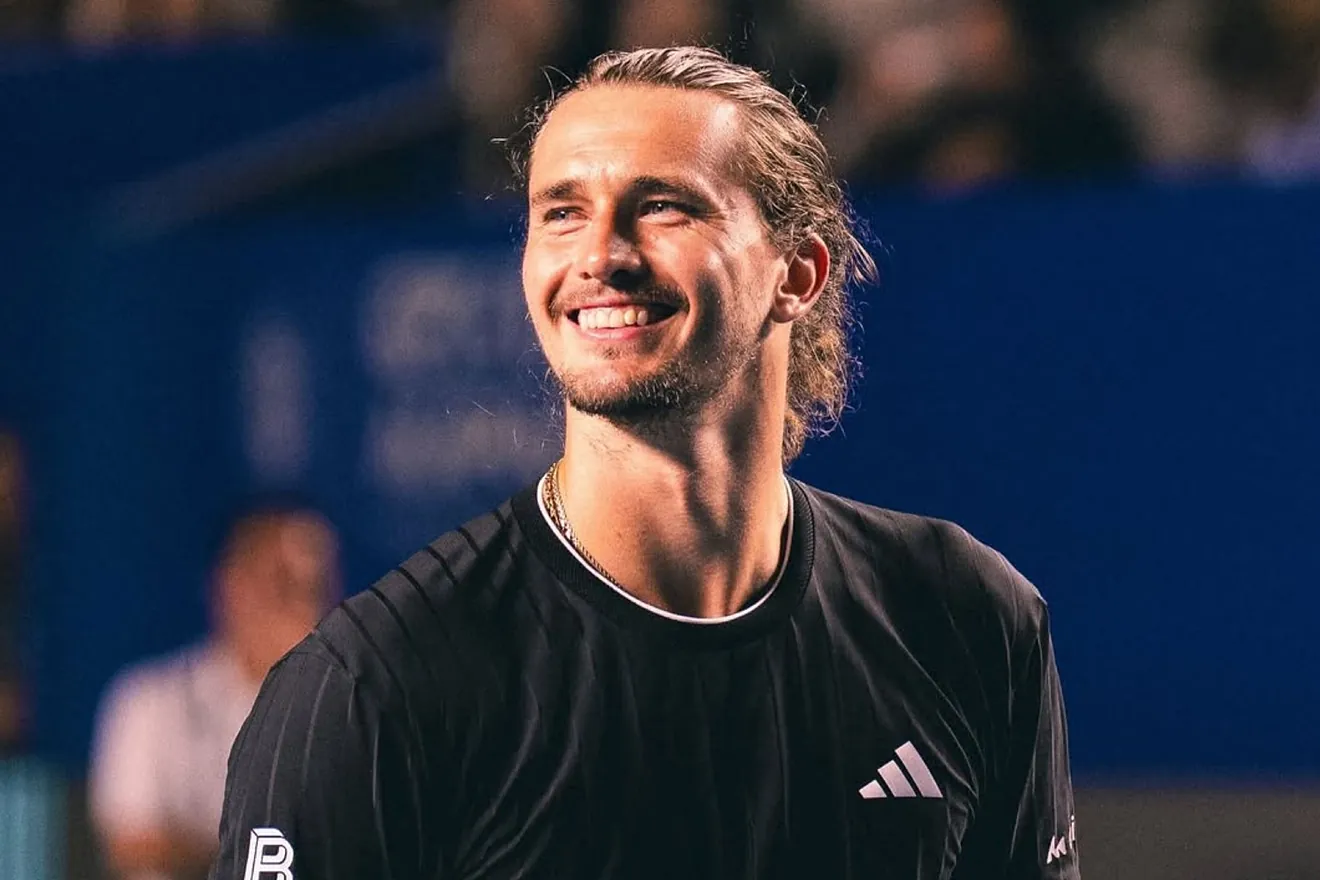
Picture a camera broadcasting a tennis match — showing one person only. The entire match. In our case: Alexander Zverev.
It follows him everywhere. How he enters the court. How he walks back to the baseline after a long rally. How he waits. How he serves. How he sits down between sets. How he picks up the racquet before the next point begins.
Could you tell — from his body language alone — whether he is facing one of his so-called "nemeses"?
When I gave my first coaching sessions at sixteen — kids’ training — I stopped correcting at some point. Instead I told a nine-year-old boy: "Imagine you are Nadal right now."
In the very next rally the boy played visibly better — beaming, carrying a clear mission: I am the No. 1 now. Nadal.
Imagination and visualisation are, in my experience, the most effective ways to adopt a completely new bearing from one point to the next.
"Sascha" has been one of the most dominant players on tour for ten years now. He beats Djokovic. He beats Alcaraz. He wins ATP Finals, Masters titles, Olympic gold. At 28, healthy (aside from his type 1 diabetes) and in the form of his life, he stands among the few who can beat anyone.
And yet something seems missing for that inner peace: the first Grand Slam title. The tennis community remains split into two camps because Sascha carries a kind of kryptonite with him. One camp says: he will never win a Grand Slam. The other says: "It’s coming. He is still growing."
Both sides have arguments. Both hold on to them regardless of what happens. That is what makes the Zverev case so particular: he supplies each camp with enough evidence for whichever conviction wants to be fed.
During the last three weeks at the Sunshine Double — the Masters tournaments Indian Wells & Miami Open — he positioned himself clearly in interviews. He wants to play more aggressively, take more risks, and make the step that remains outstanding.
Sascha gives the impression he wants to change something. Is shifting one gear higher in risk-taking enough? Does it win the decisive points when he faces his greatest opponents?
And what would the camera show the moment he faces one of them again — even with the strategy set to "full throttle"?
A player transforming his style must feel it first, then embody it. In the way he approaches the baseline. In the way he talks to himself. In that moment before the serve — whether the routines match his tempo.
And then comes Sinner.
Seven consecutive losses against him. Is this story written by the media — or is it already fully scripted in Sascha’s head before the match?
What happens inside Zverev before the first ball of the match is struck? What transcript would his inner dialogue produce the night before the match. The hour before. The moment he sees the name in the draw.
"I’ve never felt this empty before."
That was Wimbledon 2025, after the semi-final. A sentence like that comes from someone who is searching. For something his titles have owed him until now.
Part of me feels a kind of compassion, that his self-confidence remains relatively shakeable despite a singular career. Another part of me wants to scream onto the imaginary canvas of his biography:
"Sascha, play what you have long known you understand. You are not here to enter the stadiums as a guest on your own stage. You have already reached the point of carrying even greater greatness onto the most magical courts in the world. Your legend status does not hang on the last point won at the tournament. The legacy begins with the first step onto Centre Court where you KNOW something and no longer hope."
Many people also forget that Sascha lives with type 1 diabetes and proves to the world once more that everything is possible. At the same time, I know people who have made illnesses or injuries part of their identity. May Zverev’s story continue to be an encouragement for "limited" players and never become an invisible weighted vest, pulled on before every match out of unconscious self-pity.
The video footage of the past ten years of matches already exists. And I have watched a great many of them.
Weeks of footage. With today’s technology, his body language alone could be analysed — step frequency, gaze direction, shoulder angle during warm-up, posture shifts between sets. All visible, all measurable.
I myself am close to the decision of using AI to take all of this apart sequentially. And no, that does not take us a step back towards GEN 01 (see article No. 1). We are gaining awareness of the story his presence tells.
Roger Federer once put it this way: even the most successful players win only 50% of all points in their career. What defines them is the other 50% — and the state from which they play those points.
I say: Alexander Zverev wins his first Grand Slam in 2026 on clay — and it will be the tournament of his career that he approached most playfully and offensively. The Zverev who wins this final will be a different one from the man who lost three Slam finals before: fearless offence.
Dear Sascha: I already know you are a living legend. Do you know it too?
PS: An awakening player does not hope, nor does he believe any longer. He knows.
Imagine a camera pointed at you during your next practice session, your next match — uninterrupted, showing only you. Your body language. Your expression. Every micro-slip of your face between the points.
How would your game change?