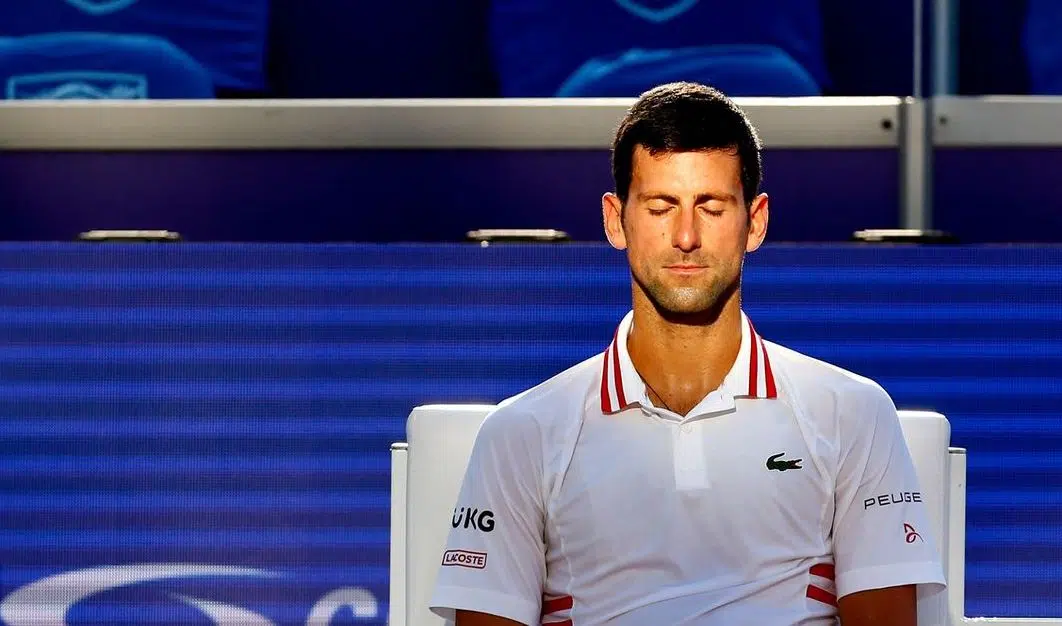
A man stands on a tennis court in front of fifteen thousand people. He has just lost what is probably the most decisive point of the match. His mind tells him it is over. That he is too old. That his legs will no longer carry him. And this man — the most successful tennis player who ever lived — needs exactly four seconds to silence that inner voice.
Four seconds and one breath. On we go.
What happens in those four seconds is the true masterpiece behind twenty-four Grand Slam titles. And it has remarkably little to do with the sport itself.
A widespread myth in elite sport still holds today: the best doubt less. Novak Djokovic doubts in every single match he plays. He says so himself — publicly and unequivocally. Every time he feels fear, insecurity and the thought that this time it might not be enough either. The difference between him and the rest of the world, however, lies in one single, decisive place. And it is neither talent nor years of experience.
It is the speed at which he comes back.
In the well-known YouTube interview with Jay Shetty, Djokovic tells a story that, in my view, every athlete and every non-athlete should hear. His mental coach visited a Zen master in a temple in France some time ago and asked him: “How do you do it? Nothing throws you off balance. You seem to live without negative thoughts.” The teacher answered: “The opposite is true. I probably have more negative thoughts and challenging emotions than you. More inner storms. The difference: I stay in them for seconds. You stay ... who knows how long.”
Seconds. That is the entire difference.
And here begins what I call worry management. We frequently confuse habitual, constantly repeating thoughts with real feelings — and mistake the repetition of a thought for proof of its truth. Djokovic himself says: nobody on this planet — no monk, no priest — lives without negative thoughts. There is no human being who does. The question was also never whether doubt arrives. The question is how long it gets to stay.
How long do you remain in the state that separates you from your clearest version?
Between points on the court, Djokovic uses conscious breathing as his reset mechanism. Slow exhalations that bring his nervous system back to calm. Conscious breathing under pressure — that is one of his bridges back into focus. Yet breathing is only the surface of a much deeper practice. At the age of ten, his first mentor — he calls her his “tennis mother” — introduced him to visualisation and meditation. Classical music before sleep, poetry as part of his preparation and a journal as a constant companion. These tools became the foundation on which one of the greatest athletes in sport history later built his inner architecture.
And because I am very aware of this challenge of worry management, I built a solution for myself and have since been able to help many people with the same approach.
For eight years now I have been producing my own audio recordings. Usually three to four minutes long. All based on a written manifest that describes the highest and clearest version of myself — the way I am when I live one hundred per cent connected to who I truly am. Real and without any compromise.
I then record the text myself, set to fitting music and binaural frequencies that bring me into the right state. I listen to this audio every morning. And I listen to it before the decisive moments of my life — before sport competitions just as much as before important conversations that demand my clarity.
The purpose behind it: what I once recognised about myself with full clarity remains accessible in the moment when doubt arrives or a negative spiral begins. Three minutes are enough to remind me of who I really am. The mere certainty of having this audio with me is enough in some situations to master the mental shift. And this mechanism is also the greatest lever I share with my athletes. A tool that makes them independent of me. A tool that turns them into self-reliant, awakening players — because in the most important moments on the court or in life they have access to their own truth, without anyone having to stand beside them.
Bianca Andreescu, who won the US Open in 2019 at the age of nineteen, wrote herself a fake winner’s cheque for that exact tournament when she was fifteen. She meditates every morning, visualises her day and describes this practice as the core of her breakthrough. The tools differ in their detail. The principle remains identical: whoever keeps their clearest version within reach will not be governed by habitual thoughts.
Over the past two decades I have witnessed how Novak Djokovic was publicly pilloried time and again for exactly these practices. When he chose not to be vaccinated against COVID-19, he was deported from Australia in 2022 — detained in an immigration facility, then expelled from the country, just days before the Australian Open (where he had the chance to cement himself once and for all as the GOAT of tennis). He later spoke of how that experience still traumatises him to this day.
When he spoke of structured water and the idea that emotions can influence the molecular structure of water, he was branded a conspiracy theorist. When he radically switched his diet to gluten-free — following a diagnosis based on energy medicine — he was ridiculed for it. And when he refused for two years to have surgery on his injured elbow because he believed in the body’s power to heal itself, he was called naive. After the operation he eventually did undergo, he wept for days — because he felt he had betrayed himself.
There is a deep irony here for me. The same people who want to know how a human being wins 24 Grand Slams and still stands at the top approaching forty criticise exactly the practices that carried him there — the moment those practices challenge their own worldview. The interest is enormous. But only as long as the answer remains comfortable.
I am explicitly not saying that every path Djokovic has taken is the right one for every other person. What I am saying, however: the willingness to walk your own path with conviction and to withstand the headwind for it is itself a form of worry management. Because the greatest worry of many people is the opinion of others.
Worry management therefore means neither having no worries nor suppressing them. It means building a conscious relationship with what happens inside one’s own mind. Thoughts arrive and repeat themselves until they feel like reality. But a habitual thought is not a feeling. And a worry is not a truth.
The ability to find your way back to focus within seconds is trainable. Djokovic breathes consciously between points. I listen to my manifest before the decisive moment arrives. Bianca Andreescu wrote her dream on a cheque at fifteen and cashed it in four years later. Your path will be a different one.
But the first step is always the same: to recognise that the duration decides. How long do you stay in the state that keeps you small?
Your trained mind is only one conscious decision away. Every single day.
Take three minutes today. Write down how you would describe yourself when you are one hundred per cent connected to who you are — without doubt, without the voices from outside. Read this text aloud to yourself in the evening. And then listen to how the words feel when they come from you.
Trust your own voice.
Between the Lines appears as always on yessvisions.com — and always when there is something truly important to say.