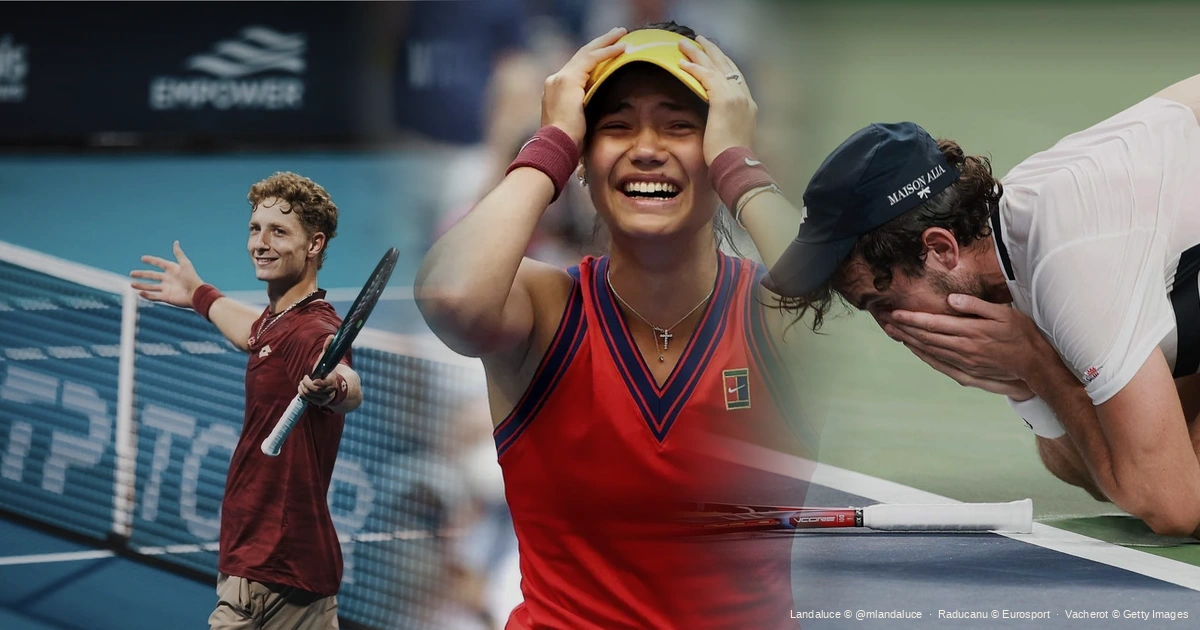
We all love these stories. They feel like the birth hours of our heroes, and just one week earlier the outcome would have seemed aeons away. There would probably not even have been odds to bet on this result.
The athletes themselves need these moments. And so does every single spectator — each one experiencing a reminder of the magic that a single week is enough to turn an entire life upside down. Some things take many years (or even decades) to become reality overnight. Is it not a wonderful mystery that we cannot understand everything in linear terms and therefore become protagonists of incredible stories ourselves? One more question this article will bring to the surface:
Are we even still there when our greatest dream suddenly knocks?
When Marco Trungelliti stepped onto the court for his first ATP final last week (April 2026 in Marrakech), he was 36 years old with eighteen professional years on the clock. Enough time to have experienced everything at some point. In theory. Only the final was something he had never experienced — because he had never reached one.
What makes this story remarkable lies beyond the result of the final. It lies in what accompanied him to that point. In 2015, Trungelliti was contacted by so-called 'match-fixers' — a network with clear prices and a clear offer. He declined and filed a detailed report with the Tennis Integrity Unit. He could have stayed silent, as most in his position have done or still do. The consequence of his integrity was isolation in the locker room, personal threats and fleeing Buenos Aires. Fellow players publicly labelled him a traitor for breaking an unwritten code. And Trungelliti played on for eighteen years — until Marrakech 2026, where he became the oldest player in the Open Era to break into the top 100 for the first time and played his very first ATP final.
Emma Raducanu arrived at the 2021 US Open ranked No. 150 in the world, played through the entire three-round qualifying draw and went on to win the whole Grand Slam — ten matches, not a single set dropped. Emma became the first qualifier in Open Era history to win a Grand Slam. She was eighteen years old and competing in only her second Grand Slam tournament. Anyone watching her results in the months before the breakthrough would have found no reason for any form of hope.
Another example: Valentin Vacherot flew to Shanghai in October 2025 — without knowing whether he would play at all. He stood outside the qualifying list at the time, gambled on a last-minute withdrawal, and still did not land in the draw. Only one day before the official start of qualifying did he get in. His own quote afterwards: 'When I landed here, I wasn't even supposed to play the tournament. I took a little gamble to come play.'
That week he beats Bublik, Rune and Djokovic and wins the Masters 1000 final against his own cousin Arthur Rinderknech. Before him, no player in ATP history with a ranking of 204 had claimed this title. The ATP later named this story the breakthrough of the year 2025. I can only urge you to watch the emotional highlights of this unbelievable tournament story once more. You will start your day with a different kind of belief. I promise.
Budapest, April 2026. Just last week I sat with my fifteen-year-old mentee Vincent Selmeczi, who a few months ago had the best tournament of his career. When I asked him what his personal secret during that tournament week was, his answer: 'No idea.'
Then I wanted to know, from his perspective, how his peaceful road to the final unfolded. He answered again against probably all expectations: 'I was in pain throughout the entire tournament, 0-6 down in the quarter-final, called the physio twice, smashed a racquet.'
Does this sound at first glance like the path of an awakening player?
Yes. To me, Vincent is one of the most awake athletes I have accompanied in my career as a mentor. Every day he is ready to take full responsibility for what happens to him and asks himself with courage: 'How can I change sport for the better once I stand on the biggest stages in the world and people ask me why I held on this long.'
Vincent, I believe in you!
More proof awaits: Victoria Mboko came to Montreal in 2025 — ranked #333 with a wild card. In a single week she beat Kenin, Gauff and Rybakina — three players with Grand Slam titles — and stood in the final against Naomi Osaka. She played on a stage as though it were exactly the right size for her. Still not convinced what is possible in a single week?
And then there is Martín Landaluce, 20 years old, Spanish, who as a qualifier ranked #151 reached the quarter-final of a Masters 1000 at the Miami Open 2026 just weeks ago — the lowest ranking of a quarter-finalist in Miami since 1994. Rafael Nadal publicly congratulated him afterwards. Landaluce is still in the middle of it. His ONE week was just the starting gun. We will see whether his story earns its place in this blog too.
Five different players. Five different stories. I follow every score in tennis in great detail every day. But when you look through the tournament results of these players in the six months before their breakthrough weeks, you find little remarkable — first rounds, qualifying losses, barely any ranking movement.
So what happened that made something this heroic suddenly possible?
I do not want to talk about flow right now, nor about mental strength in the classical sense. Because what connects these five players is something I would not presume to name with certainty. What I do know well:
To never let a person forget, and to keep reminding them of what is truly possible when they believe in their highest innate power. And that requires a particular form of remembrance. Something that is always within reach in the moments that matter and defeats every doubt, every worry in the process. That is where my task as a mentor lies. To strengthen belief and keep it alive when it is truly needed.
Because breakthroughs and heroic moments do not arrive because something has suddenly changed physically. They are the moments when readiness meets opportunity. And these stories can be written by anyone in their life — every week and every day.
That is the message I want to address to everyone who finds themselves at a similar point right now: you want it. But your results do not reflect it yet. You wonder whether it is still worth investing — staying with this dream when the results are telling you a different story. Look at these five players. The breakthrough did not come before they stepped onto the court. It came because they refused to stop playing: when Vacherot boarded a plane to Shanghai without knowing if he would even get to compete. When Trungelliti entered qualifying for the eighteenth time. When Raducanu at eighteen years old started a tournament she had no idea would turn her life upside down.
Belief is no guarantee of the outcome. But it is the only bridge leading to the tournament that changes everything.
Your 'tournament' exists. The question is whether you are still there when it comes.
Consider this article a reminder for you and your most deeply anchored dreams. In a week, everything can look different. Maybe by tomorrow morning. Trust that you can trust.
Between the Lines appears as always on yessvisions.com — and always when there is something truly important to say.