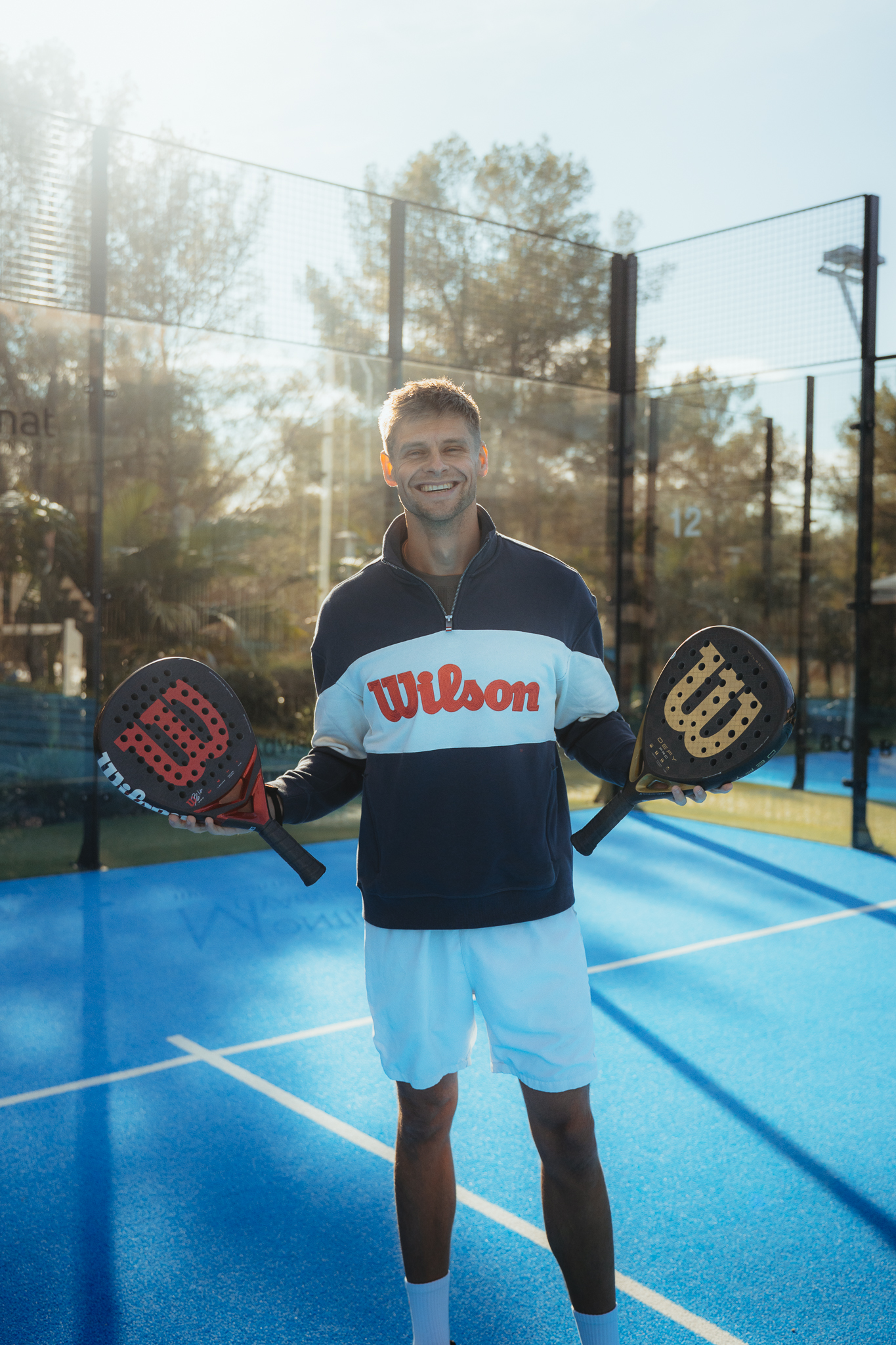
I know what it feels like when your body goes numb from exhaustion. Thousands of hours on the court. Tennis, padel — competitive sport as a way of life. And I know the other side: the frontier of the mind. Silent retreats, multi-day ceremonies, deep inner work. Coaching given, coaching received.
The more the competitive sport chapter closed in my life, the deeper I entered the world of consciousness exploration. One experience more revealing than the last. And it became increasingly clear to me how one-dimensional many approaches still are — in training, from the media side, and consequently in public perception. Systemic understanding (not to be confused with: systematic) is something I see far too rarely.
A question I keep allowing myself to ask: are the athletes of our time developing at all? What messages reach me as a spectator — someone who follows with every fibre — when I watch the greatest sporting events in the world?
Millions of people look up to these gods in sportswear every day. During the football World Cup. At the four annual tennis Grand Slams. At the Olympic Games. But what exactly are we looking up to?
The technique? The scoreline?
Or something expressing itself through these people — something larger than the medal, the world ranking and the time on the clock?
Many questions. And I believe they deserve to be asked.
What fascinates us about these athletes rarely lies in their results.
Professional sport has spent the last decades optimising everything that can be optimised.
Body, technique, athletics — the body as a machine that lifts weights and runs kilometres. That was GEN(eration) 01. A revolution that worked. Then came GEN 02: the mind as a second muscle. Visualisation, pressure management, mental strength. Anyone playing without mental training today plays with one hand tied behind their back.
And right now we find ourselves at GEN 02.1 — the current hype. Longevity. Biohacking. Sleep optimisation. Inflammation markers. Biological age. Behind it all, the promise: play longer, perform longer, stay young longer.
What I see is a gap: nobody asks what all of this is for.
Michael Phelps won 23 Olympic gold medals. More than any human in the history of the Olympic Games. And he described how he fell into deep depression after every triumph. Once. Twice. Every time. After London 2012 he wanted to stop living.
23 gold medals. The most complete optimisation programme swimming has ever seen. And still.
Naomi Osaka was the highest-paid female athlete in the world. Four Grand Slam titles. Then she withdrew from the public eye. Because of the weight behind everything. She asked herself a question that occupies many athletes but almost nobody voices out loud: if I feel this way, why should I push through instead of healing it?
In my view, one of the most honest questions in elite sport to date. And probably the rarest, which makes it the most important.
Simone Biles, the greatest gymnast of all time, stepped back at the Tokyo Olympics — and returned three years later in Paris, stronger than ever. What had changed: she no longer competed "for others".
All athletes at the summit. All arriving at the same realisation.
Who am I, actually, when I'm (not) playing?
A question of identity, without doubt. And deeper than any technique we can devote ourselves to for the thousandth time.
GEN 03 begins right there.
With the willingness to look for the player behind the athlete. The person behind the performance. The question behind the question.
Nutrition, biomechanics, athletics. The body as a machine to be optimised. That was a revolution. It worked.
Visualisation, pressure management, resilience. The mind as a second muscle. Real progress. Anyone playing without mental training today plays with one hand tied behind their back.
Biohacking, sleep optimisation, inflammation markers, biological age. The promise: play longer, stay young longer. The gap: nobody asks what for.
Through my interest and my work I observe emerging professional athletes asking themselves new questions. Questions that have never mattered before and reach beyond their trophy ambitions. What does a world-class player embody who has found inner peace and steps into the arenas of the world? What remains when everything else goes? Is an avant-garde of athletes emerging who pursue peak performance only in service of a personal message?
Tim Gallwey put it fifty years ago: performance emerges where interference stops.
Interference — the inner noise. The comparison. The critic in your head. The fear of the next mistake. Everything that makes a player smaller than who they are.
GEN 03 is the state where that noise stops. Science calls it flow. Spirituality calls it presence. In sport you recognise it immediately: the athlete where you sense — that person is all there.
The flip side of all this is what I call the optimisation trap — something I experienced first-hand.
The conviction that the next method or experience is the missing piece. That you must prepare completely before you are allowed to begin. That inner work must always precede action.
Often that holds true. And sometimes it is the most elegant form of avoidance.
Because the playing field (you can call it life) carries its own intelligence. It shows you who you are the moment you start playing. No seminar in the world can replace that.
Depth without real movement keeps circling the same cosmos. Movement without depth flattens over time. The feedback loop between both — that is the systemic.
Being. Doing. Having. — a timeless law of our lives. The origin of all change lies in being. And at the same time life is dynamic: if doing does not follow, even the most beautiful state of being stays invisible. What gives me the greatest joy in this field: it is the exact threshold where the visible blurs with the invisible, and in the end personal conviction determines which sequence of this law shapes one's reality.
That is what makes the path alive.
A player — as I understand the word — is an athlete at their most awake. Fully present. Acting from personal truth. Carried by who they are, not driven by fear of the outcome. It is lived authenticity. But when is the right moment to start asking these questions? In childhood? During puberty? Or only once the first big titles sit on the shelf (and the evening in the hotel room feels lonely)?
We already know great athletes who seem to have understood this game more than others, and that is exactly why we will dedicate ourselves to their stories. Because it inspires. Because it inspires, to be able to change and grow at any time (or to have to?).
I write this blog because I believe sport stands at a threshold.
The tools of GEN 01 and GEN 02 are valuable. They remain part of the path. GEN 03 brings back what sport is in its deepest form: a mirror. An invitation to see deeper rather than just run further.
The athlete who fascinates today is often the most authentic one. The one where you sense: that person embodies something larger than the point, the goal or the time on the clock.
That can be shown. That can be lived.
It starts with a question you can ask yourself today:
Who are you, actually, when you're (not) playing?